
What Does DOJs Renewed Focus on Healthcare Fraud Mean for Healthcare and Life Sciences Companies?

On May 12, 2025, the U.S. Department of Justice's (DOJ) Head of the Criminal Division, Matthew R. Galeotti, issued a memorandum titled “Focus, Fairness, and Efficiency in the Fight Against White-Collar Crime.”outlining its renewed focus on combating white-collar crime, with a significant emphasis on healthcare fraud and abuse. This directive underscores the DOJ's commitment to safeguarding public funds and ensuring the integrity of healthcare programs, presenting a renewed opportunity for healthcare and life sciences organizations to bolster their compliance programs.
Healthcare Fraud, Waste, and Abuse is the Criminal Division's #1 Priority in Its Fight Against White-Collar Crime
In the memorandum, Galeotti delineates three core principles guiding the DOJ's approach: focus, fairness, and efficiency. Specifically with regard to healthcare, he noted: "Rampant health care fraud and program and procurement fraud drain our country’s limited resources." This framework reinforces DOJ's efforts to detect and prosecute fraud schemes involving federal healthcare programs such as Medicare and Medicaid. These schemes often involve significant financial harm and erode public trust in essential services.
Importantly, the DOJ reaffirmed that its top enforcement priority remains the prosecution of individuals—particularly senior-level personnel or other culpable actors—rather than corporations alone. According to the memo, individual wrongdoers are often responsible for misconduct that harms shareholders, employees, investors, and consumers. Prosecutors have been instructed to prioritize cases involving demonstrable losses, obstruction of justice, or executive-level schemes, reflecting a clear directive to pursue meaningful deterrence.
Considerations in Corporate Prosecution
While individual accountability is the primary goal, the DOJ recognizes that corporations may also bear responsibility under certain circumstances. However, the memo cautions that not all corporate misconduct warrants criminal prosecution. Prosecutors are directed to weigh several critical factors before charging a company, including:
Whether the company voluntarily disclosed the misconduct to the DOJ,
The degree of cooperation during the investigation, and-
Any remedial actions taken to address the wrongdoing.
This nuanced approach aims to balance effective law enforcement with the need to avoid imposing unnecessary burdens on American businesses.
Implications for Healthcare and Life Sciences Companies
Healthcare and life sciences companies should prepare for heightened enforcement by reviewing their billing practices, documentation procedures, and compliance protocols. DOJ enforcement will likely focus on schemes such as:
Billing for services not rendered or medically unnecessary,
Kickback arrangements involving referrals or preferred vendors, and
Improper use of relief funds or federal reimbursements.
The DOJ's memo underscores a commitment to proportionate enforcement, but that should not be mistaken for leniency. Organizations can expect robust investigations when serious wrongdoing is suspected, particularly when senior leaders are involved or evidence of willful misconduct exists.
Strengthening Compliance in a High-Risk Climate
Given this evolving enforcement landscape, healthcare organizations should take proactive steps:
Conduct internal audits to detect and correct potential compliance failures.
Enhance training programs for staff to identify and avoid fraud risks.
Establish secure internal reporting channels to surface misconduct early.
These steps not only reduce legal exposure but demonstrate a company’s good-faith efforts to prevent violations—something the DOJ may consider favorably if enforcement becomes necessary.
Conclusion
The DOJ's latest memo places renewed emphasis on individual accountability, corporate responsibility, and healthcare fraud prosecution. Accordingly, industry actors should review and strengthen their compliance programs, particularly in areas most vulnerable to enforcement scrutiny.
Recent Posts
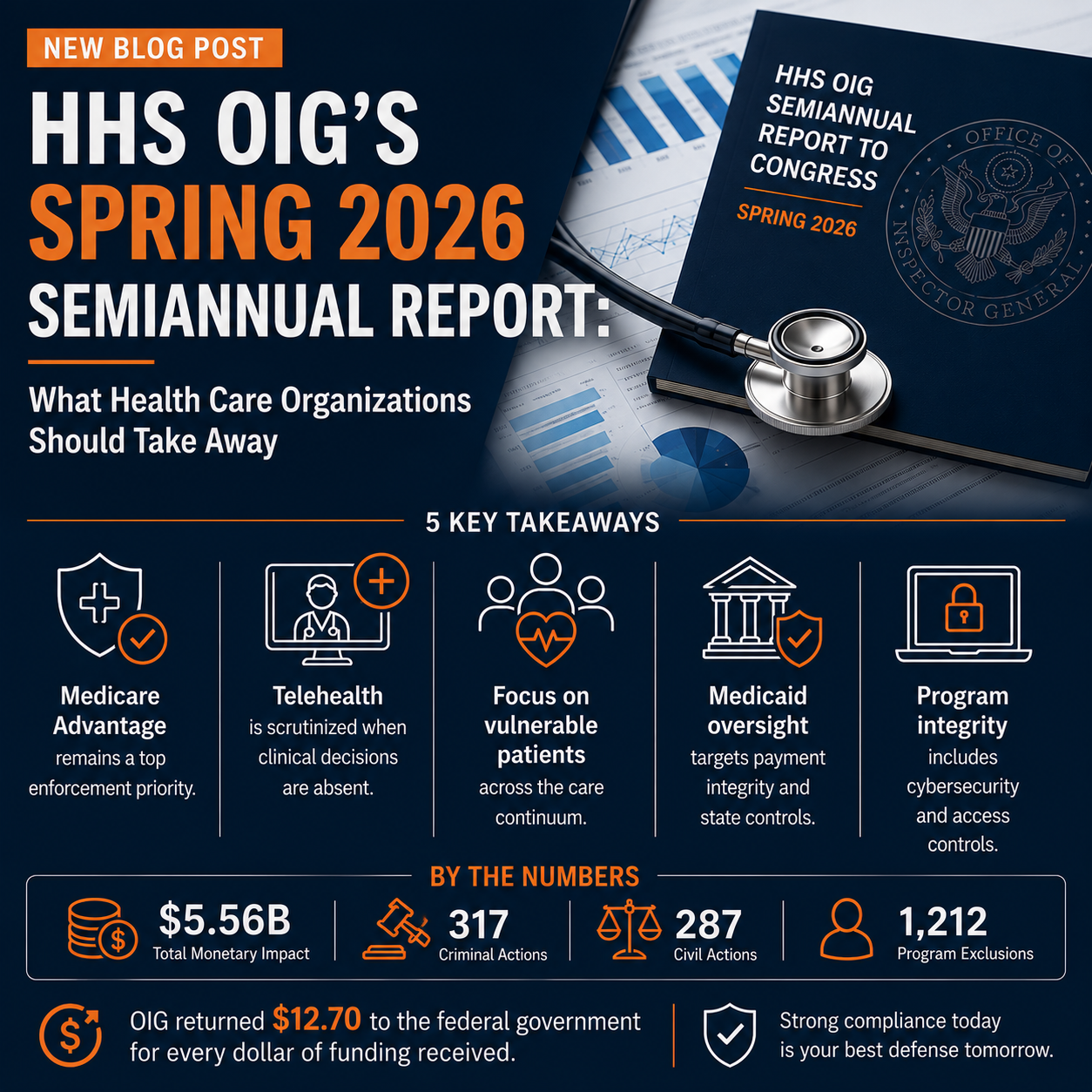
HHS OIG’s Spring 2026 Semiannual Report: What Health Care Organizations Should Take Away
For the six-month reporting period ending on March 31, 2026, OIG reported $5.56 billion in total monetary impact, including $4.3 billion in investigative receivables, $814.1 million in audit and evaluation receivables, and $447.6 million in identified potential cost savings. OIG also reported 317 criminal actions, 287 civil actions, and 1,212 program exclusions. The agency stated that it returned $12.70 to the federal government for every dollar of funding received.
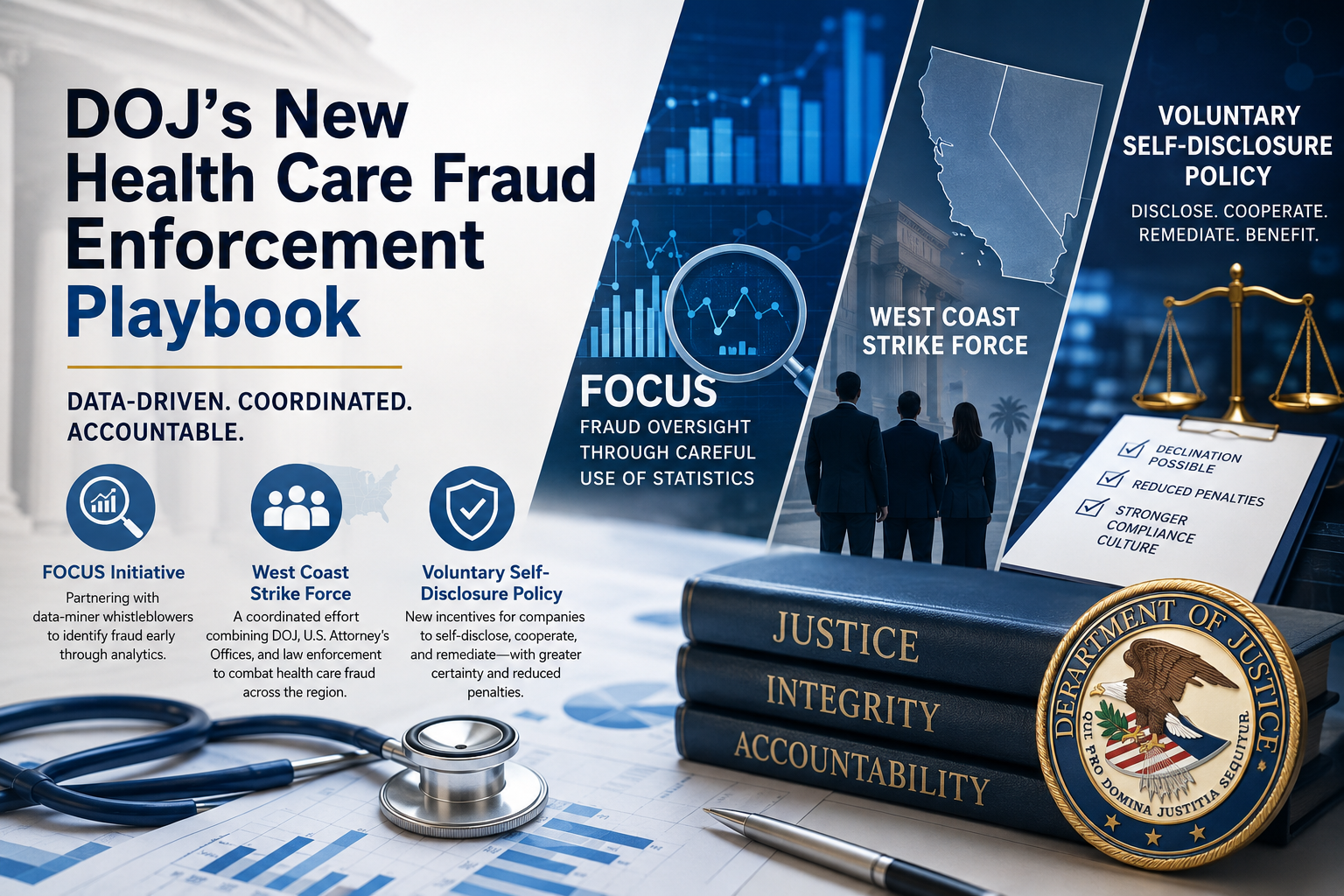
DOJ’s New Health Care Fraud Enforcement Playbook Is Data-Driven, Coordinated, and Moving Fast
The DOJ’s latest healthcare fraud enforcement initiatives—including the FOCUS initiative, new strike forces, and updated voluntary disclosure incentives—signal increased scrutiny for providers, startups, and healthcare companies.
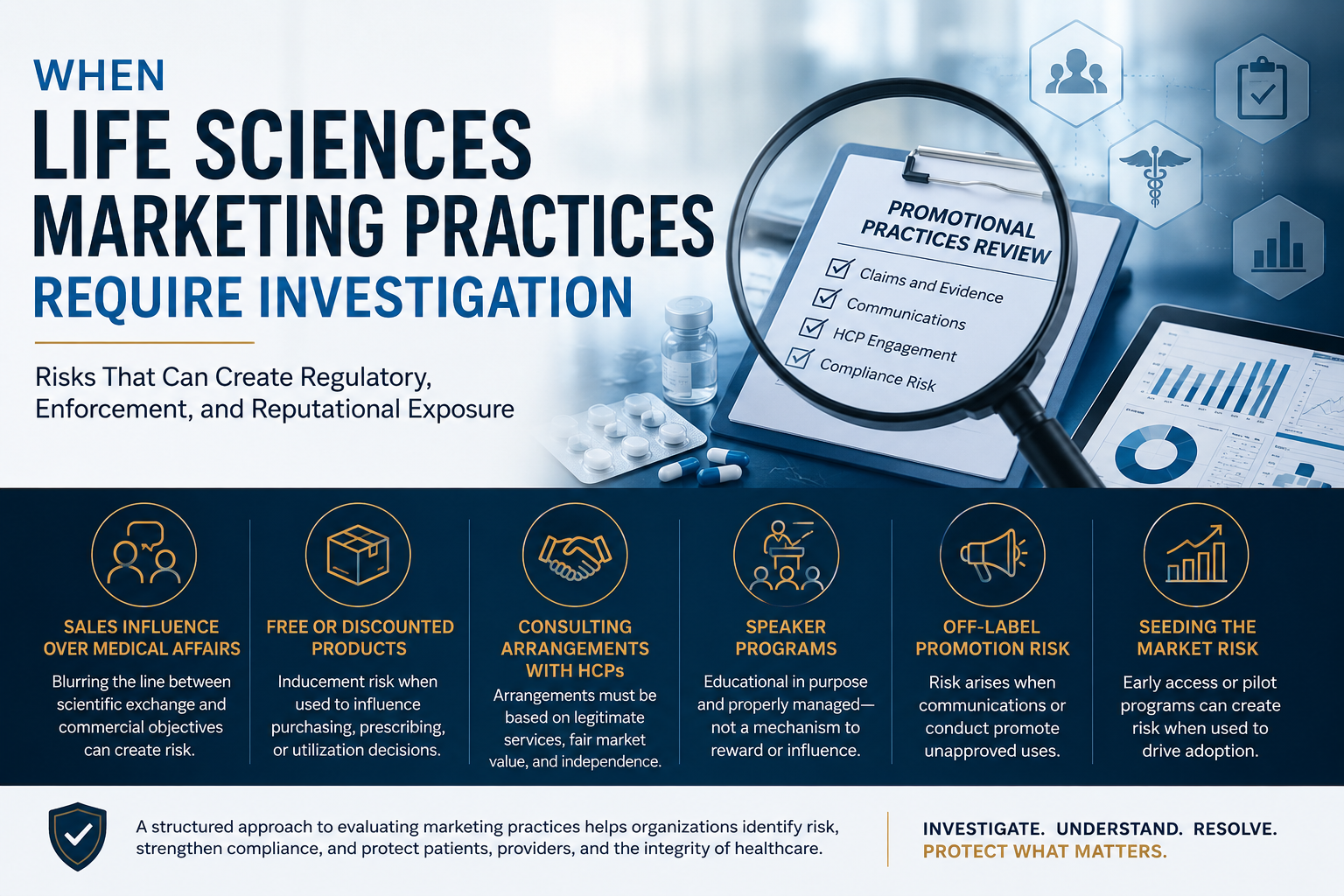
When Life Sciences Marketing Practices Require Investigation: Off-Label Promotion, HCP Arrangements, and Anti-Kickback Risk
Most promotional issues do not begin as obvious compliance failures. They often surface through a sales deck, a field communication, a speaker program, a consulting arrangement, a discounting strategy, or questions about how medical affairs is interacting with healthcare professionals. At the outset, the issue may appear to be a routine marketing or training concern. Over time, however, the surrounding facts can change the analysis.