
When Financial Relationships Require Investigation: Stark Law and Anti-Kickback Risks in Healthcare

Financial relationships in healthcare operate under a level of regulatory scrutiny that few other industries encounter. Compensation arrangements, consulting agreements, medical directorships, and referral-related relationships routinely involve overlapping operational, business, and legal considerations. Most are established for legitimate purposes and function without issue for years.
The challenge is that risk in this area rarely announces itself. Concerns typically surface gradually — through an audit finding, a compensation review, a diligence process, or an internal question about how a particular arrangement actually operates. In some cases, the issue only becomes visible once patterns begin attracting external attention.
At that point, the organization is no longer simply asking whether an arrangement is defensible on paper. It is evaluating whether the relationship, viewed in full context, creates meaningful regulatory exposure.
How These Issues Typically Surface
Concerns involving Stark Law or the Anti-Kickback Statute rarely begin with an explicit allegation of impropriety. More often, they emerge through routine compliance or operational activity.
An internal review may identify compensation that appears inconsistent with historical benchmarks or fair market value analyses. A diligence review may surface agreements that are incomplete, outdated, or operationally inconsistent with how services are actually being performed. Referral data may reveal patterns that warrant closer examination — particularly where compensation increases alongside referral volume or utilization trends.
In other situations, concerns arise through employee complaints or whistleblower allegations. Individuals involved in contracting, finance, or operations may question whether an arrangement is being administered as documented, or whether certain relationships are receiving exceptions not applied consistently elsewhere.
Early on, these issues are often framed as documentation or operational problems. The analysis becomes more complex once questions arise about how the arrangement functions in practice — and whether the available documentation accurately reflects that reality.
Stark Law Exceptions and AKS Safe Harbors
Understanding the regulatory frameworks that govern financial relationships requires more than familiarity with what the statutes prohibit. It also requires understanding the mechanisms through which compliant arrangements are structured — and the very different legal consequences that follow when those mechanisms are not satisfied.
Stark Law: Strict Liability and the Role of Exceptions
Stark Law prohibits physicians from referring patients to entities with which they or an immediate family member have a financial relationship for the furnishing of designated health services billed to Medicare or Medicaid — unless a specific statutory or regulatory exception applies. The exceptions are numerous and cover a wide range of common arrangements, including employment relationships, personal services arrangements, fair market value compensation, in-office ancillary services, and bona fide employment by a hospital, among others.
What distinguishes Stark Law from other regulatory frameworks is its strict liability structure. Intent is not an element of the violation. If a financial relationship does not satisfy the precise requirements of an applicable exception — including requirements related to compensation methodology, written documentation, and the absence of volume or value-based payment — the referrals are improper and the resulting claims are non-reimbursable, regardless of whether the parties believed the arrangement to be compliant or acted in good faith. There is no safe harbor analysis, no intent inquiry, and no balancing of equities. Either the exception is met in full, or it is not.
This strict liability framework has significant practical implications. Technical deficiencies that might appear minor in isolation — an agreement that lapsed without renewal, compensation that was adjusted without adequate documentation, or duties that shifted over time without a corresponding amendment — can render an otherwise legitimate arrangement non-compliant. For that reason, Stark analysis requires careful attention not only to whether an exception exists in principle, but to whether the arrangement satisfies every applicable requirement throughout the entire period it has been in place.
The Anti-Kickback Statute: Safe Harbors and the Limits of Their Protection
The Anti-Kickback Statute operates differently. It prohibits the knowing and willful offer, payment, solicitation, or receipt of remuneration to induce or reward referrals of items or services covered by federal healthcare programs. To provide clarity and protection for common business arrangements, the Office of Inspector General has established a framework of regulatory safe harbors — specific categories of conduct that, if fully satisfied, are protected from AKS scrutiny.
Safe harbors exist for a broad range of arrangements, including employment relationships, personal services and management contracts, space and equipment rentals, fair market value compensation arrangements, and others. Like Stark exceptions, safe harbors impose specific requirements, and full compliance with those requirements provides meaningful regulatory protection.
However, a critical distinction separates the AKS safe harbor framework from Stark's exception structure: failing to satisfy a safe harbor does not establish a violation. An arrangement that falls outside a safe harbor — or that meets most but not all of its requirements — is not automatically unlawful. Instead, it must be evaluated on its own facts to determine whether the arrangement involves the knowing and willful offer or receipt of remuneration intended to induce or reward referrals.
That evaluation requires examining the purpose and structure of the arrangement, the relationship between compensation and referral activity, whether the parties understood the arrangement to be connected to referral volume or value, and how the arrangement compares to legitimate market practices. Arrangements that do not fit neatly within a safe harbor may nonetheless be defensible if they reflect genuine fair market value compensation for legitimate services with no improper referral purpose.
This distinction matters considerably when evaluating risk. For Stark Law, the threshold question is whether an applicable exception is fully satisfied. For the Anti-Kickback Statute, the absence of safe harbor protection shifts the analysis to intent and purpose — a more fact-intensive inquiry that requires a careful assessment of how the arrangement was structured, administered, and understood by the parties involved.
When a Concern Becomes Investigative
Not every financial relationship concern requires a formal investigation. Isolated documentation gaps or technical deficiencies can often be addressed through targeted corrective action and additional oversight.
Systemic issues are a different matter. Repeated inconsistencies across arrangements, compensation methodologies that are difficult to support, undocumented changes in duties or payment structures, or referral patterns that raise questions about the purpose of the arrangement may all warrant a more structured review. The same is true where concerns involve senior leadership, high-revenue referral sources, or arrangements affecting multiple entities or service lines.
In those situations, the organization needs to assess potential regulatory exposure and consider how the arrangement may appear to enforcement agencies. The process itself becomes consequential. Evaluating financial data, communications, operational practices, and historical decision-making in a coordinated, structured manner is not optional — it is part of managing the risk appropriately.
Downstream False Claims Act Exposure
Stark Law and Anti-Kickback concerns do not exist in isolation. One of the more significant — and sometimes underappreciated — aspects of these frameworks is how violations can generate downstream False Claims Act liability.
The connection is structural. Under the FCA, submitting a claim for payment to a federal healthcare program that the organization knows to be false or fraudulent exposes it to substantial civil liability. Where a financial relationship violates Stark Law, claims submitted to Medicare for designated health services rendered as a result of that relationship are generally considered tainted — regardless of whether the underlying services were medically necessary and appropriately performed. The violation of the referral prohibition is itself sufficient to render the resulting claims non-reimbursable.
The Anti-Kickback Statute carries similar consequences. Following amendments to the ACA, a claim that includes items or services resulting from an Anti-Kickback violation constitutes a false or fraudulent claim under the FCA. This means that what begins as a compensation or referral arrangement concern can quickly become an FCA exposure problem measured not by the value of the arrangement itself, but by the volume of claims submitted during the period the arrangement was in place.
The financial stakes are considerable. FCA liability includes treble damages — three times the amount of each false claim — plus per-claim civil penalties. Where an arrangement has been in place for multiple years and generated significant referral volume, the aggregate exposure can be substantial even where the underlying compensation at issue was relatively modest.
This exposure also shapes how these matters are investigated and resolved. Qui tam relators — private individuals who file FCA suits on behalf of the government — frequently identify Stark or Anti-Kickback concerns as the predicate for their allegations. Government investigations that begin as inquiries into financial relationships routinely expand to encompass the full scope of claims submitted during the relevant period. Voluntary self-disclosure, when appropriate, can be a meaningful tool for limiting exposure, but the decision to disclose requires a careful assessment of what the review has identified and how the arrangement is likely to be characterized by enforcement agencies.
For these reasons, organizations assessing a financial relationship concern should not evaluate Stark and Anti-Kickback risk in isolation. Understanding the potential FCA implications — and the volume of claims that may be implicated — is an essential part of any complete regulatory exposure analysis.
Common Mistakes in Handling These Issues
One of the more frequent mistakes organizations make is treating these concerns as purely transactional problems — focusing on whether the agreement contains the right contractual language without examining whether the arrangement actually operated consistent with those terms.
In other cases, reviews remain narrowly focused on documentation while overlooking operational realities. Compensation may technically fall within a valuation range, but the services actually performed may be unclear or inconsistently documented. Referral trends may be evaluated independently from compensation structure, even where the relationship between the two warrants closer examination.
Organizations also sometimes approach early-stage concerns too informally. Reviews may begin through disconnected conversations among legal, compliance, finance, and operations teams — without a defined scope or investigative structure. As additional concerns emerge, the lack of coordination makes it harder to evaluate the issue consistently and preserve a coherent record of the organization's response.
Taking a Structured Approach
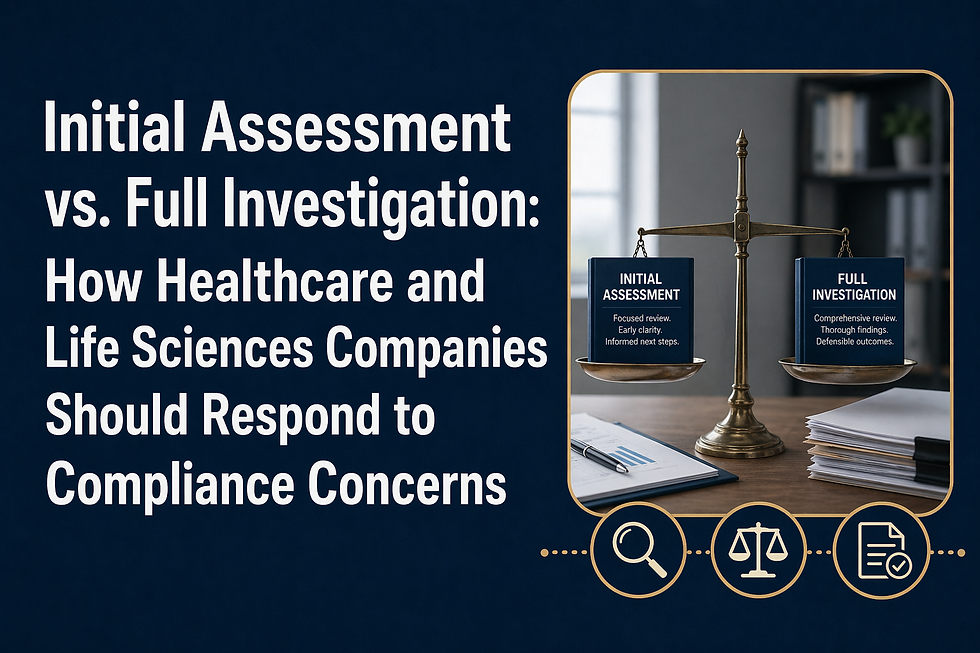
When concerns involving financial relationships begin to raise broader regulatory questions, a structured assessment helps determine the appropriate path forward.
That process typically begins with a focused review of the arrangement itself — including supporting documentation, compensation methodology, operational practices, and relevant financial or referral data. The goal at this stage is to understand whether the issue appears isolated or whether it reflects broader risk requiring additional review.
Where concerns remain limited, corrective action and enhanced oversight may be sufficient. Where the review identifies patterns, inconsistencies, or potential exposure affecting multiple arrangements or business units, a more comprehensive investigation may be necessary.
The objective is not to evaluate contractual compliance in the abstract. It is to understand how the arrangement functioned in practice, how it may be assessed under applicable regulatory frameworks, and whether additional action is warranted to address the associated risk.
Key Takeaways
Concerns involving financial relationships typically surface through audits, diligence reviews, or operational inconsistencies — not direct allegations
Stark Law is a strict liability statute — if an applicable exception is not fully satisfied, the resulting claims are non-reimbursable regardless of intent or good faith
Failing to satisfy an AKS safe harbor does not establish a violation; arrangements outside a safe harbor are evaluated on their facts, with intent and purpose as central considerations
Stark and Anti-Kickback violations can render downstream Medicare and Medicaid claims false under the FCA, creating treble damage exposure tied to referral volume rather than the value of the arrangement itself
Qui tam relators frequently use Stark and Anti-Kickback concerns as the predicate for FCA suits, and government investigations often expand to encompass the full claims period
A structured review helps organizations assess scope, evaluate risk, and determine whether additional investigation is warranted
Financial relationships are a routine part of operating in healthcare, and most arrangements are established for legitimate business purposes. The challenge lies in recognizing when an issue reflects more than a technical compliance concern — and requires a broader assessment of regulatory risk.
That determination often depends less on the existence of the arrangement itself and more on what becomes apparent once the organization begins examining how the relationship actually operated in practice.


Comments